

What if…
Clinicians didn't have to rebuild years of treatment at every visit.
Patients didn't have to try to piece together months of their own care on the spot.
Patients report what changed as it happens. Bluecarta assembles it with EHR history into a reusable treatment timeline and summarizes what changed for the clinician.
THE PROBLEM
The treatment story is still reconstructed at every visit
More than 200 million Americans live with a chronic condition managed across years, with visits often months apart. What matters most happens in the interval, and almost none of it reaches the chart.
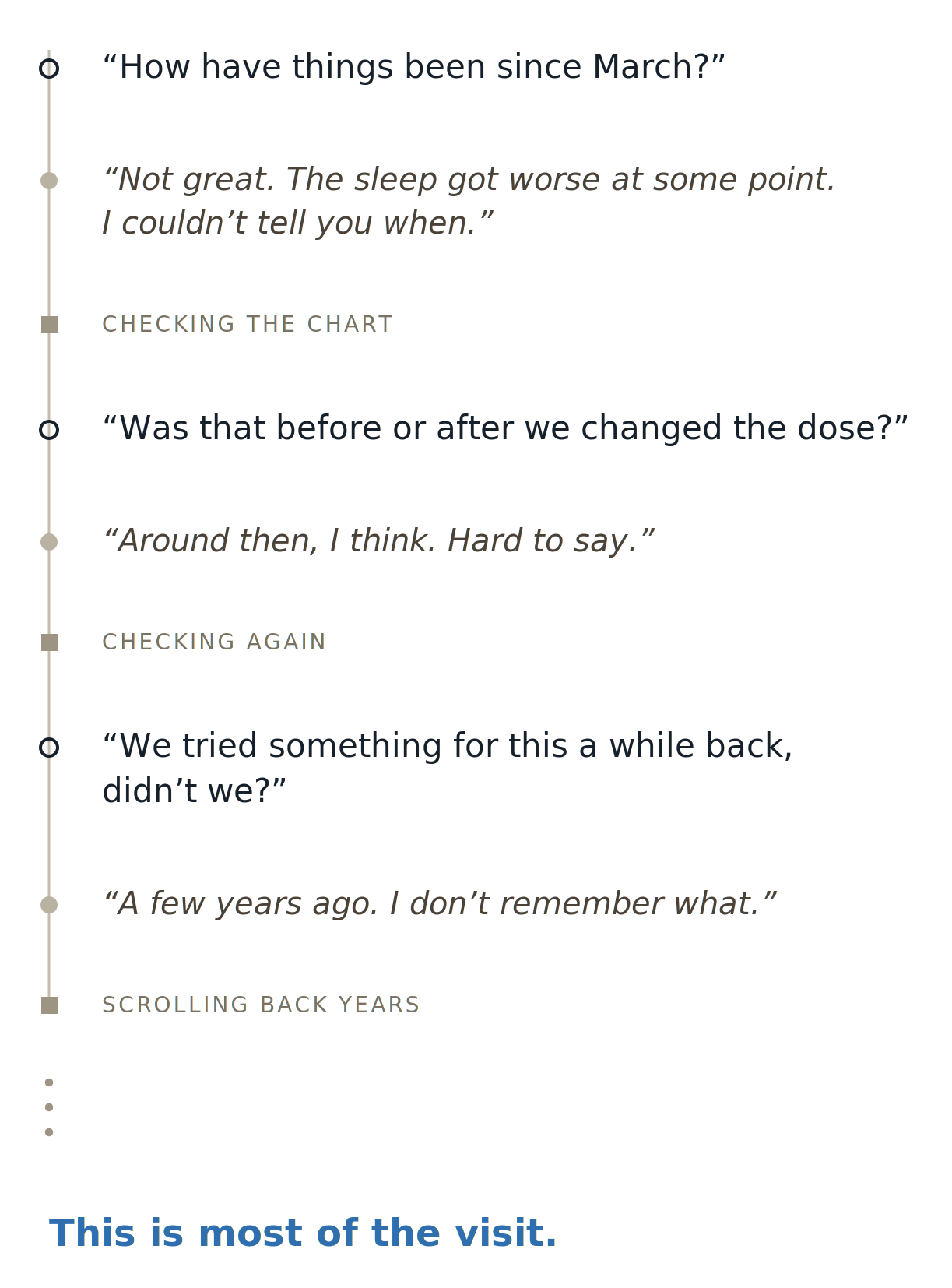
So the treatment story gets rebuilt at every appointment. What happened since the last visit, reconstructed from patient memory. What has been tried over years, reassembled from the chart. Both cross-checked until the picture is good enough to decide from.
Chart review is the measured part of the cost, and it counts only time spent in the record. In behavioral health, more of the reconstruction happens out loud, in the room, and no one has counted that.
Bluecarta starts in behavioral health because the gap is widest there: almost nothing objective accumulates between visits.
* Overhage & McCallie 2020
THE SOLUTION
AI that turns patient change into clinical context
Patients contribute between visits.
Bluecarta assembles.
Clinicians see the treatment story in the EHR.

1. Capture what happens between visits
Patients submit observations, mood, sleep, assessments, and side effects, self-logged and AI-prompted at clinically meaningful moments:
Before a visit: "Anything you want to make sure we cover tomorrow?"
After a dose change: "It's been two weeks on the new dose. How are you doing?"
After a new prescription: "Any side effects since starting?"
Patient-initiated, anytime: "Rough week. Anxiety is back."
2. Assemble the treatment timeline
Patient input and EHR history come together into a single view: what changed, what was tried, and how the patient responded. The timeline is built once and expands with every check-in, every medication change, and every visit.
3. Prepare the clinician
A concise summary of what changed since the last visit, ready before the encounter begins.
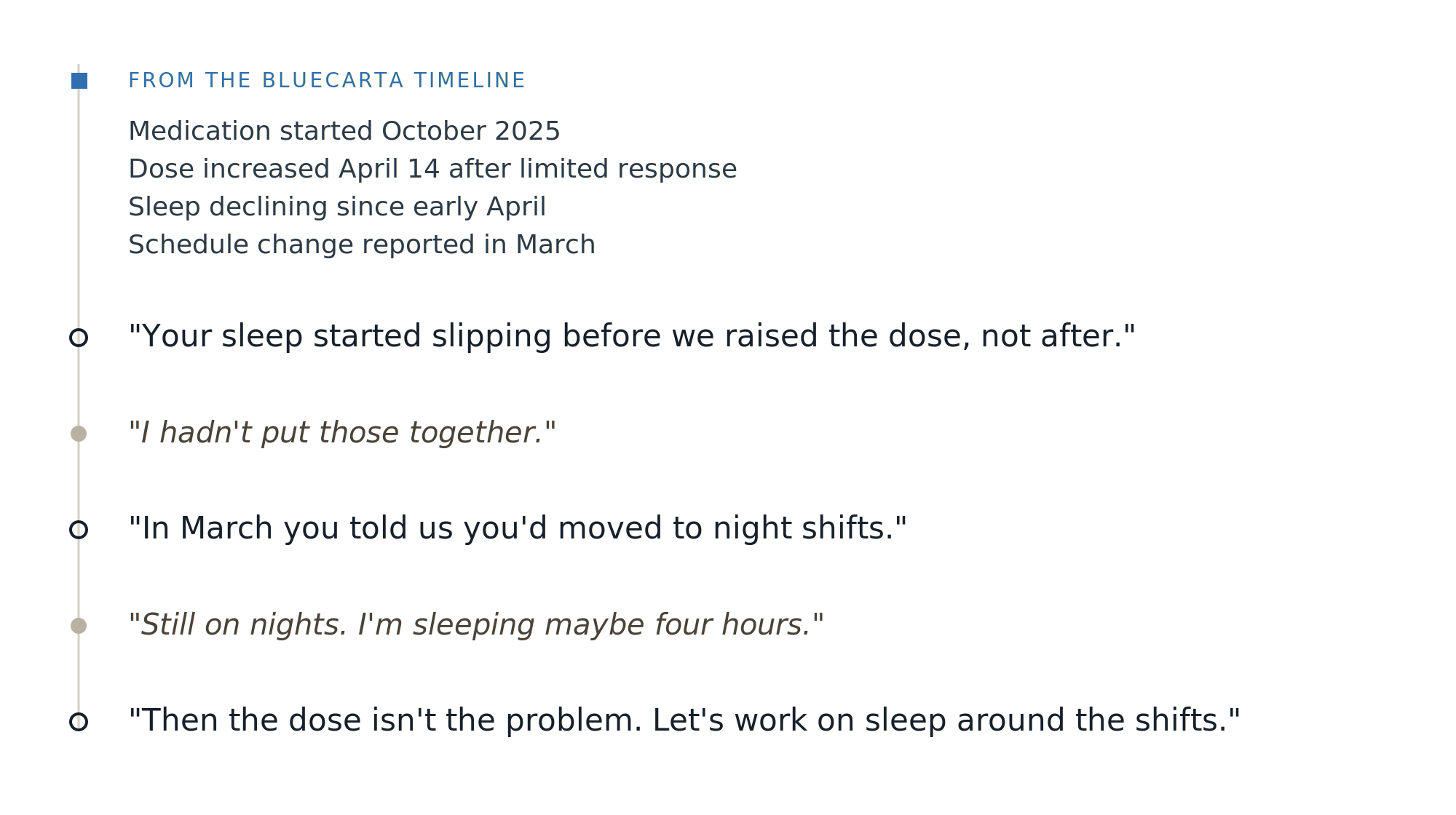
The reconstruction is largely done before the visit starts. Patients don't have to piece it together on the spot. They already said it, and they hear it come back.
"I see your sleep has worsened over the last two months, what's going on there?"
Less time reconstructing, more time treating. Patients who are heard keep contributing.
WHAT CHANGES
Same visit, different conversation
Less time reconstructing, more time treating. Patients who are heard keep contributing.
SCIENTIFIC ADVISORY BOARD
Clinicians shaped this from the start
Charles Nemeroff, MD, PhD, Chair of Psychiatry at UT Austin Dell Medical School, leads a board of seven across five academic medical centers, spanning psychiatry, clinical psychology, and integrated care delivery.







OUR BELIEF
Clinicians can only act on what they can see
The system has never been designed to show them what changed between visits.
Bluecarta exists to change that. For every patient, every clinician, every day.
GET IN TOUCH
Interested in what we're building?
We work with health systems, clinical leaders, and investors who believe the treatment story belongs at the center of care.
We'd love to hear from you.